By Chetanya Sarraf
Aqara spatial sensor fp400
Smart homes are becoming more responsive, but traditional motion sensors can struggle when someone remains seated, sleeps, or works quietly in one place. The Aqara Spatial Sensor FP400 addresses this limitation with millimetre-wave radar technology designed to detect human presence, track movement, and support intelligent home automation.
Rather than simply switching lights on when movement occurs, this sensor can help a smart home respond to where people are located and how they move through a room. With the ability to monitor specific areas and track multiple people, it offers homeowners a smarter way to automate lights, temperature settings, and other smart home functions.
What Makes Its Sensing Technology Different?
The FP400 uses high-precision millimetre-wave radar to recognise human presence and movement. Unlike basic motion detectors that primarily react to movement, radar-based presence sensing can detect subtle movements associated with a person remaining relatively still.
This capability can improve automation in bedrooms, living rooms, home offices, and other spaces where people may sit quietly for extended periods. For example, connected lighting could remain active while someone reads at a desk instead of switching off simply because the person has stopped moving noticeably.
The sensor also measures ambient light levels, allowing compatible automations to consider both occupancy and illumination. This can help create more comfortable lighting routines without requiring users to operate switches manually.
Multi-Person Tracking and Custom Zones of Aqara spatial sensor fp400
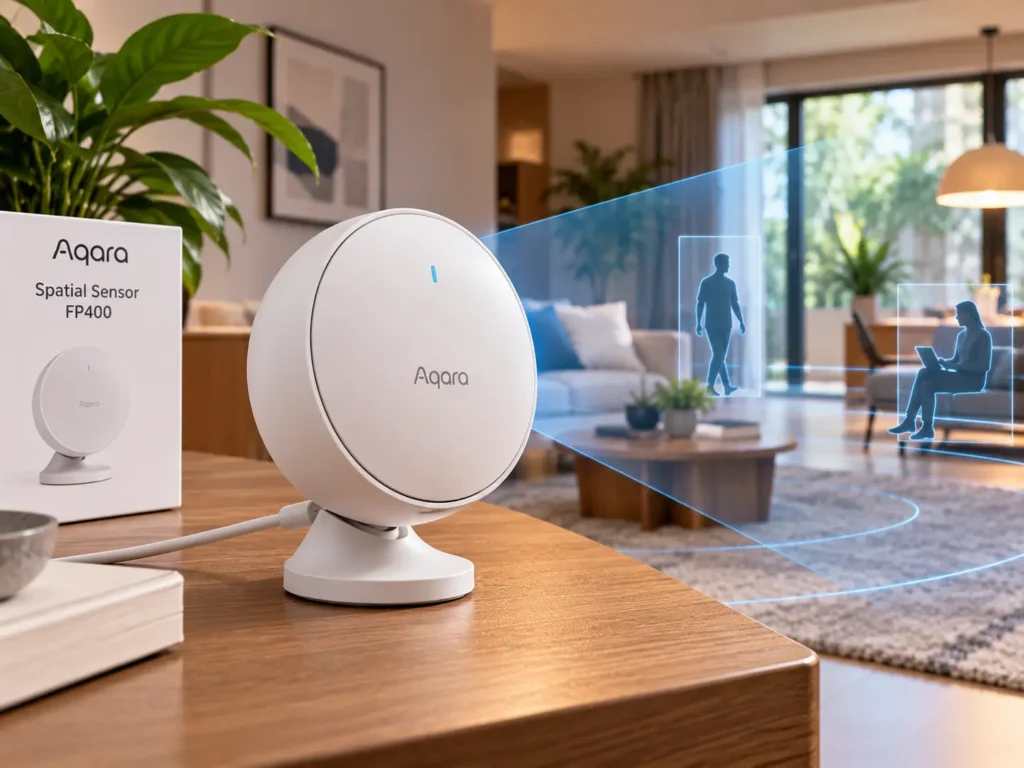
One of the FP400’s standout capabilities is its ability to track multiple people within a monitored area. According to Aqara’s documentation, it can track up to ten targets simultaneously and supports as many as eight custom zones.
These zones allow users to divide a room into meaningful areas, such as a sofa, workstation, dining table, or entrance. Automations can then respond to activity in specific locations rather than treating the entire room as one space.
Picture a living space where the lighting increases as someone walks toward a reading chair, while the area around the television stays softly illuminated. Similarly, a home office could activate selected equipment when someone enters the workstation area.
The sensor can also identify movement direction and approaching or departing targets. However, detection accuracy depends on placement, environmental interference, and the distance between people. Closely grouped targets can sometimes be difficult to distinguish reliably.
Smart Home Compatibility and Connectivity
The FP400 supports Zigbee and Matter-based integration, offering flexibility for different smart-home arrangements. Its complete capabilities depend on the connection method, compatible hub, application, and third-party platform.
For the broadest feature set, Aqara recommends configuring the device through its own ecosystem with a compatible Aqara hub. Custom zones and advanced automation options may not transfer completely to every third-party platform because supported features differ between ecosystems.
This matters for households already using connected lighting, switches, sensors, and voice assistants. Before buying, users should verify that their existing hub supports the required protocol and that their preferred automation features are available.
When configured correctly, the sensor can help create routines that respond to occupancy, movement, and environmental brightness. These routines can reduce unnecessary manual interaction and make connected devices feel more coordinated.
Installation and Detection Coverage of Aqara spatial sensor fp400
The FP400 supports wall, corner, and ceiling mounting, with adhesive, magnetic, or screw-based installation options depending on the mounting surface and accessories.
For wall installation, Aqara recommends a height of approximately 1.5 to 2 metres. Ceiling installation is generally recommended at heights between 3 and 4 metres. The device’s orientation and tilt angle influence the area it can monitor.
Aqara documents a maximum wall-mounted detection range of up to 10 metres forward and 8 metres wide under suitable conditions. Actual coverage can be smaller because of room layout, obstructions, reflective surfaces, and installation angles.
Glass, mirrors, metal surfaces, fans, and moving curtains can interfere with radar readings. Aqara’s app provides zone configuration and spatial-learning tools that can help users reduce unwanted detections. Careful placement and initial calibration are therefore important parts of setup.
,Build , Power and Everyday Reliability of Aqara spatial sensor fp400
The sensor connects through USB-C and requires a 5V, 1A power source. Built for permanent use instead of cordless mobility, the device requires access to a nearby power outlet for uninterrupted operation.
Its IPX5 rating indicates protection against water jets under specified test conditions. This offers some flexibility for suitable indoor environments, although it does not mean the device is suitable for immersion or every outdoor installation.
Anyone looking for the Aqara spatial sensor fp400 manual should use Aqara’s official documentation for pairing, mounting height, zone setup, protocol selection, firmware updates, and troubleshooting. Following these instructions can help minimise false detections and improve the reliability of automations.
Pros and Cons
Pros
- Detects presence beyond basic movement sensing.
- Tracks multiple people and supports eight custom zones.
- Supports Zigbee and Matter integration.
- Offers flexible mounting and ambient-light detection.
Cons
- Full functionality requires compatible Aqara equipment.
- Reflective surfaces and moving objects can cause interference.
- Requires continuous USB-C power.
- Advanced setup may take time to configure correctly.
Frequently Asked Questions
- What is the Spatial Multi Sensor FP400?
The Spatial Multi Sensor FP400 is a smart-home presence sensor using millimetre-wave radar to detect people, track movement, and support zone-based automation.
- Does the FP400 detect people sitting still?
It can detect subtle movements associated with stationary human presence, although results depend on positioning, sensitivity settings, distance, and environmental conditions.
- Does the Aqara FP400 require a hub?
A compatible Aqara hub is recommended for full functionality. Direct Matter pairing with third-party platforms may provide fewer features.
- Can the FP400 control smart lights automatically?Yes. When connected to compatible devices and configured in a supported smart-home ecosystem, it can trigger lighting automations based on presence, movement, zones, and ambient light.
Final Verdict
The Aqara Spatial Sensor FP400 offers a more detailed approach to smart-home presence detection than a conventional motion sensor. Multi-person tracking, custom zones, and flexible connectivity make it useful for households seeking more responsive lighting and room-based automation. With proper setup and compatibility with existing smart home devices, it can serve as a useful addition to an automated home environment.